To concern oneself with ‘Shakespeare’s shipwrecks’ is probably a good example of a narrow focus interest. Why should anyone bother? Well – I do not know if anyone will bother. But let me explain how I got interested in that topic and how I investigated it.
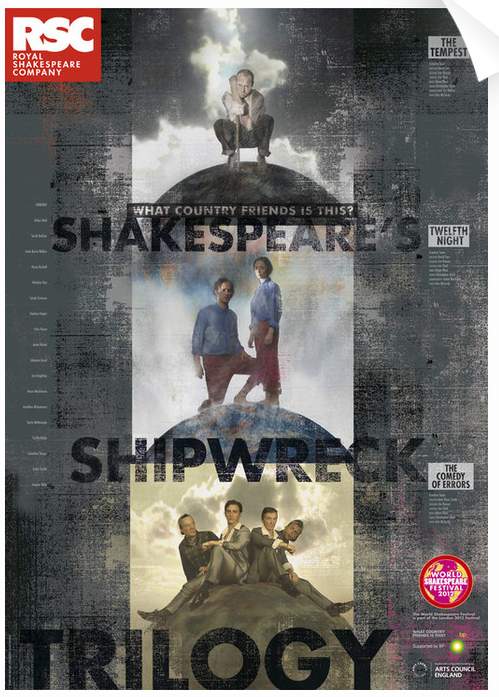
I clearly remember the starting point. In 2014 or 2015, the opportunity arose to concern myself more intensively with Shakespeare’s plays. At some point I found a reference to ‘Shakespeare’s Shipwreck Trilogy.’ The RSC had chosen this headline for its staging of The Comedy of Errors, Twelfth Night and The Tempest in 2011. RSC’s archive of past productions refers to it now as ‘What Country Friends Is This?’-trilogy.
That made me think. Several plays, in which shipwreck is also important for the development of the plot, came to mind. In The Merchant of Venice, the whole predicament of Antonio is caused by the (presumed) loss of his ships. In Othello, the Turkish fleet is devoured by a storm, that conveniently leaves the ‘Christian’ ships unscathed. And so on.
Some critics opined, regarding RSC’s trilogy, that Pericles should have been included, for in this play the protagonist has twice to endure severe real storms on the high seas, whereas the storm in The Tempest will turn out afterwards just to have been a magic trick. Beyond that, it was argued, the three plays are far too loosely unified to really form a ‘trilogy’.1
Anyway, I got intrigued by the instrumentalisation of shipwreck in Shakespeare’s plays and discovered more examples. However, in the vast amounts of literature about Shakespeare, this topic has found remarkably little representation. Many commentators appear not to regard descriptions like ‘the twins get separated by a shipwreck’ worth any discussion. The fact is just accepted without any further consideration. And that serves the playwright well, of course.
My ‘research questions’ began to take shape.
(1) Why is shipwreck used so often in the plays? Is it because shipwreck is such a convenient dramatic means not requiring any explanations – or is it simply such an important or attractive topic?’ Soon it became apparent that the answer to this will probably have to be: both!
After formulating the initial problem, further issues arose. For instance:
(2) What constitutes the attractiveness or importance of shipwreck stories?
And finally, there is the crucial question about
(3) how all this relates to reality.
How frequent were shipwrecks in Shakespeare’s time?
How did theatrical use relate to real-life importance and actual frequency of shipwreck events?
Is there any way to know this?
Interestingly enough, The Tempest contains a rather self-conscious reference to exactly this issue:
Gonzalo:
Beseech you, sir, be merry. You have cause –
So have we all – of joy; for our escape
Is much beyond our loss. Our hint of woe
Is common: every day some sailor’s wife,
The masters of some merchant, and the merchant
Have just our theme of woe. But for the miracle –
I mean our preservation – few in millions
Can speak like us. Then wisely, good sir, weigh
Our sorrow with our comfort.
(Tem 2.1.1–9, my emphasis)2
My preoccupation with the topic became more and more intensive and coincided with pandemic-related restrictions. The most intensive phase of research took place in 2020 and 2021.
The literature about Shakespeare is in itself ‘vast as the sea.’ While I found wonderful publications about single aspects of my abovementioned queries, I didn’t find the one book or article providing the answers I looked for.
Several colleagues and friends encouraged me, therefore, to write a book myself. ‘If you haven’t found a similar argument in the literature, you should publish yours’, one of them said. I am thankful to him (and others, who did not let me forget about the book project) for the support.
In approaching my questions, I do not take the direct route, but start with some detours.
First, I offer my thoughts about the ‘caveats’ of all Shakespeare discussions and, inherently, also for my own book. Short chapters investigate (and disclose my opinions about) the issues (1) of realism in Shakespeare’s plays, (2) of overinterpretation of these works and (3) of weird and unpleasant aspects in the plays.
After that I provide full disclosure about myself and list the conventions applied in this work.
Next – before focusing in on the shipwrecks – the relationship between ‘Shakespeare and the sea’ is examined regarding Shakespeare’s use of metaphors and imagery. I show where and how sea and ship phrases and metaphors are used in the plays and which meanings are conveyed by them.
The next and main part starts with listing all the instances of shipwrecks encountered in the canon of plays, including also pirates as another important hazard to navigation. The ‘shipwreck plays’ are discussed in detail, with the aim to identify regularities and patterns in all the shipwreck scenes, and to demonstrate the progression in the means of theatrical depiction.
Attention is further given to the metaphoric content of shipwrecks and to the attractiveness of shipwreck narratives. Shipwreck is also compared to other plot elements frequently used in the plays and to other travel-related hazards that the playwright used to propel his stories.
Relating all this to the history of boating and shipping, to known works of earliest literature containing seafaring narratives and to a short discussion of Shakespeare’s time itself I present my conclusions.
I find five plays in which shipwreck has an essential importance for the plot – and four more, where it has at least some relevance for one aspect of the play. Two plays mention shipwreck at least passingly. Beyond that, Romeo and Juliet employs an intricate metaphorical pattern focused on nautical issues.
Shakespeare’s time certainly was an era of change, upheaval and uncertainty, not long after war against the Spanish, and shaken to the foundations by multiple crises. On the other hand, this time teemed also with optimism, excitement and hope; and there was a strong belief in and excitement about discovery.
The amount of navigation and exploration related literature was unprecedented.
However, it was still in the Renaissance, with its continuing interest in classical authors and their frequent mention of naval disaster.
I think, that the old (Renaissance) and the new (expedition related) interest in shipwreck overlaps in Shakespeare’s work. And Shakespeare lived and worked in a maritime city in a maritime era, after all.
If I have already interested you in reading my book, you can find it here.
However, this website is not intended to be an advertisement only. My intention is also to present my ideas to a wider public interested in Shakespeare. I will allow myself to present from time to time short articles on Shakespeare and Shipwreck, on Shakespeare and the Sea, on the book and its author, and on other Shakespeare related issues and will invite you to give your feedback and opinions.
Stay safe and have a good time!
References:
- https://theshakespeareblog.com/2012/03/shakespeares-shipwrecks/ ↩︎
- If not indicated otherwise, all text quotations are taken from The Norton Shakespeare, ed. by Stephen Greenblatt et al. (New York: W.W. Norton & Company, 2016). ↩︎
 Shakespeare's Shipwrecks